| Acknowledgments and Introduction | ||||||||
|
"No kind
deed goes unpunished", as the sages have observed
and as it has been proven time and again. This time is no
exception, as I mete out the punishment to the kind but
modest folks who I know wish little or no mention be made
of them but will nevertheless have to suffer as they have
given their all, when I asked and are equal in the effort
this humble enterprise entailed. I would
like to acknowledge and thank my team mates on the Wahid
Smithy and T'Kur Abay Teams as well as Ethcita,
Encyclopedia Brittanica, Addis Tribune and Seven Days
Update, Drs. Samuel Kinde, Bibi Tekle Haimanot and
Semunegus Hailemariam and Engineers Asres Shifferaw,
Kefyalew Makonnen, Prince Ermias Sahleselassie and Mr.
Gregory Copley for their untiring answers to my questions,
wealth of hoarded material, and contacts.
|
|||||||
Introduction |
||
(Amharic) |
|
The Blue Nile, headstream of the Nile River, source of almost 70 - 85 percent of its floodwater and of the alluvial flood and soil on which Egyptian civilization was born, rises as a small stream from a spring 6,000 ft (1,800 m) above sea level, near Lake Tana in northwestern Ethiopia. The stream flows into Lake Tana and out as T'Kur Abay, running through a series of rapids, before it drops into a gorge flowing through a deep canyon southeast and west around the Choke Mountains. Once there it turns northwest through Sudan to join the White Nile at Khartoum. The Blue Nile is about 907 mi (1,460 km) and gets the greater part of its waters from the Dinder and the Rahad rivers, which also rise in the Ethiopian highlands. From Khartoum the Nile courses through Sudan and Egypt travelling a total of 4132 Miles(6650 Km) from its beginnings in Lake Victoria to its outflow point where it empties into the Mediterranean Sea earning it the distinction of being the longest river in the world. Currently, Ethiopia in the grips of yet another drought brought on by another failure of the Meher rains, is looking hard at short and llong erm implication of not insuring Water security and the permanent alleviation of drought through the availability of stored water resources. |
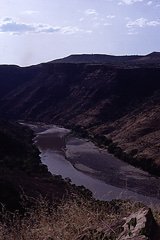
The harnessing of the Abay's waters, possible with the World bank's recent revision of lending guidelines for developmenr projects to countries sharing river systems, holds promise of alleviation of preventable human catastrophes such as the one we are in the grips of currently.
This effort, a project of the T'Kur Abay design team, is an attempt, to collect in one central location, and make available ,material important to the development of research and, hopefully, balanced and principled water sharing and usage policy so that Abay will, after all, be able to care for its children.
| - T'Kur Abay Design Team |
© 1999 Wahid Smithy